mariam.
Elite Member
- Messages
- 482
- Reaction score
- 83
- Gender
- Female
- Religion
- Islam
THE COMING OF THE UNIVERSE INTO EXISTENCE:
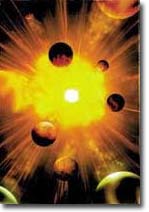
Until the mid-20th century, the prevalent view across the world was that the universe was infinite, had existed forever and that it will continue to do so for all time. According to this view, known as the "static universe model," the universe had no end or beginning.
In maintaining that the universe is a collection of fixed, static and unchanging substances, this view has constituted the basis of materialist philosophy and has consequently rejected the existence of a Creator. However, as science and technology progressed during the 20th century, the static universe model has been completely uprooted.
We have now entered the 21st century and a new dawn is upon us. Through numerous experiments, observations and calculation conducted by some of the world's most prominent thinkers, modern physics has proven that the universe did indeed have a beginning, that it came into being from nothing in a single moment in a huge explosion. Furthermore, it has been established that the universe is not fixed and static, as materialists still stubbornly maintain. On the contrary, it is undergoing a constant process of movement, change and expansion. These recently-established facts all act as nails in the coffin of the static universe theory. Today, all these facts are universally accepted by the scientific community.
The origin of the universe is described in the Qur'an in the following verse:
He is the Originator of the heavens and the earth. (Qur'an, 6:101)
This information is in full agreement with the findings of contemporary scientists. As we stated earlier, the conclusion that astrophysics has reached today is that the entire universe, together with the dimensions of matter and time, came into existence as a result of a great explosion that occurred a long time ago. This event, known as "The Big Bang," is the catalyst for the creation of the universe from nothingness. This explosion, all parties in the scientific community agree, emanated from a single point some 15 billion years ago. (See Harun Yahya, The Creation of the Universe, Al-Attique Publishers Inc. Canada, 2000)
Before the Big Bang, there was no such thing as matter. From a condition of non-existence in which neither matter, nor energy, nor even time existed-and which can only be described metaphysically-matter, energy, and time were all created in an instant. This fact, only recently discovered by modern physics, was announced to us in the Qur'an 1,400 years ago.
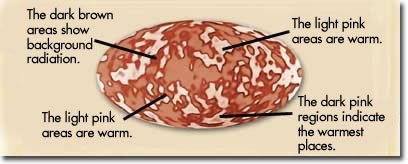 The sensitive sensors on board the COBE space satellite, launched by NASA in 1992, captured evidentiary remnants of the Big Bang. This discovery served as evidence for the Big Bang, which is the scientific explanation of the fact that the universe was created from nothing.
THE EXPANSION OF THE UNIVERSE
In the Qur'an, which was revealed fourteen centuries ago at a time when the science of astronomy was still primitive, the expansion of the universe was described in the following terms:
And it is We Who have constructed the heaven with might, and verily, it is We Who are steadily expanding it. (Qur'an, 51:47)
The word "heaven," as stated in the verse above, is used in various places in the Qur'an. It is referring to space and the wider universe. Here again, the word is used with this meaning, stating that the universe "expands." The Arabic word "moosiaaoona" in the term "inna lamoosiaaoona," translated into English as "it is We Who are steadily expanding it", comes from the verb "evsea," meaning "to expand." The prefix "la" emphasises the following name or title and adds a sense of "to a great extent." This expression therefore means "We expand the sky or the universe to a great extent." This is the very conclusion that science has reached today.
Until the dawn of the 20th century, the only view prevailing in the world of science was that "the universe has a constant nature and it has existed since infinite time." However, modern research, observations, and calculations carried out by means of modern technology have revealed that the universe in fact had a beginning and that it constantly "expands."
At the beginning of the 20th century, the Russian physicist Alexander Friedmann and the Belgian cosmologist Georges Lemaitre theoretically calculated that the universe is in constant motion and that it is expanding.
This notion was confirmed by the use of observational data in 1929. While observing the sky with a telescope, Edwin Hubble, the American astronomer, discovered that the stars and galaxies were constantly moving away from each other. This discovery is regarded as one of the greatest in the history of astronomy. During these observations, Hubble established that the stars emit a light that turns redder according to their distance. That is because according to the known laws of physics, light heading towards a point of observation turns violet, and light moving away from that point assumes a more reddish hue. During his observations, Hubble noted a tendency towards the colour red in the light emitted by stars. In short, the stars were moving further and further away, all the time. The stars and galaxies were not only moving away from us, but also from each other. A universe where everything constantly moves away from everything else implied a constantly expanding universe. The observations carried out in the following years verified that the universe is constantly expanding.
In order to gain a clearer understanding of this, let us imagine the universe to be the surface of a balloon being inflated. In the same way that the more the balloon is inflated, the further away the points on its surface move from one another, celestial bodies also move away from one another as the universe expands. This was theoretically discovered by Albert Einstein, regarded as one of the greatest scientists of the 20th century. However, in order to avoid violating the "static universe model" that was generally accepted at that time, Einstein laid that discovery aside. He would later describe this as the greatest blunder of his life.
This fact was explained in the Qur'an in a time when telescopes and similar technological advancements were not even close to being invented. This is because the Qur'an is the Word of Allah: the Creator and Ruler of the entire universe.
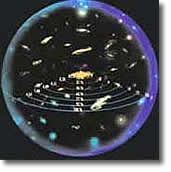 From the moment of the Big Bang, the universe has been constantly expanding at a great speed. Scientists compare the expanding universe to the surface of a balloon that is inflated.
THE END OF THE UNIVERSE AND THE BIG CRUNCH
As we have stated above, the creation of the universe began with a huge explosion. From this point, the universe has been expanding ever since. Scientists say that when the mass of the universe has reached a sufficient level, this expansion will come to an end because of gravity, causing the universe to collapse in on itself.
It is also believed that the contracting universe will end in a fierce heat and contraction known as the "Big Crunch." This would lead to the end of all forms of life as we know them. Renata Kallosh and Andrei Linde, professors of physics from Stanford University, made the following statements on the subject:
The universe may be doomed to collapse and disappear. Everything we see now, and at a much larger distance that we cannot see, will collapse into a point smaller than a proton. Locally, it will be the same as if you were inside a black hole... We have found that some of the best attempts to describe dark energy predict that it will gradually become negative, which will cause the universe to become unstable, then collapse... Physicists have known that dark energy could become negative and the universe could collapse sometime in the very distant future... but now we see that we might be, not in the beginning, but in the middle of the life cycle of our universe.
This is how this scientific hypothesis of the Big Crunch is indicated in the Qur'an:
That Day We will fold up heaven like folding up the pages of a book. As We originated the first creation so We will regenerate it. It is a promise binding on Us. That is what We will do. (Qur'an, 21:104)
In another verse, this state of the heavens is described thus:
They do not measure Allah with His true measure. The whole earth will be a mere handful for Him on the Day of Rising the heavens folded up in His right hand. Glory be to Him! He is exalted above the partners they ascribe! (Qur'an, 39:67)
According to the Big Crunch theory, the universe will begin to collapse slowly and will then increasingly pick up speed. At the end of the process the universe will have infinite density and be infinitely hot and small. This scientific theory runs parallel to the Qur'anic explanation of this particular scientific concept. (Allah knows best)
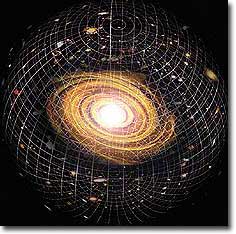 The Big Crunch theory proposes that the universe, that began expanding with the Big Bang, will collapse in on itself with increasing speed. According to the theory, this collapse of the universe will continue until the universe has lost all its mass and turned into a single point of infinite density.
CREATION FROM HOT SMOKE
Scientists today are able to observe the formation of stars from a hot gas cloud. Formation from a warm mass of gas also applies to the creation of the universe. The creation of the universe as described in the Qur'an confirms this scientific discovery in the following verse:
He placed firmly embedded mountains on it, towering over it, and blessed it and measured out its nourishment in it, laid out for those who seek it-all in four days. Then He turned to heaven when it was smoke and said to it and to the earth, "Come willingly or unwillingly." They both said, "We come willingly." (Qur'an, 41:10-11)
The Arabic word for "smoke" in the above verse is "dukhanun," which describes the hot, cosmic smoke in question. This word in the Qur'an, in pinpoint fashion, describes this smoke very accurately for it is a warm body of gas containing mobile particles connected to solid substances. Here, the Qur'an has employed the most appropriate word from the Arabic language for describing the appearance of this phase of the universe. Let us note that only in the 20th century have scientists discovered that the universe emerged from a hot gas in the form of smoke.
The fact that such information about the creation of the universe is given in the Qur'an is nothing short of a miracle of the Qur'an
THE SPLITTING ASUNDER OF "THE HEAVENS AND THE EARTH"
Another verse about the creation of the heavens is as follows:
Do those who disbelieve not see that the heavens and the earth were sewn together and then We unstitched them and that We made from water every living thing? So will they not believe? (Qur'an, 21:30)
The word "ratq" translated as "sewn to" means "mixed in each, blended" in the Arabic vernacular. It is used to refer to two different substances that make up a whole. The phrase "we unstitched" is the verb "fataqa" in Arabic and implies that something comes into being by tearing apart or destroying the structure of things that are sewn to one another. The sprouting of a seed from the soil is one of the actions to which this verb is applied.
Let us take a look at the verse again. In the verse, sky and earth are at first subject to the status of "ratq." They are separated (fataqa) with one coming out of the other. Intriguingly, when we think about the first moments of the Big Bang, we see that the entire matter of the universe collected at one single point. In other words, everything-including "the heavens and earth" which were not created yet-were in an interwoven and inseparable condition. Then, this point exploded violently, causing its matter to disunite.
THE CREATION OF WHAT LIES BETWEEN THE HEAVENS
AND THE EARTH
The Qur'an contains a great many verses concerning the creation of the earth, the heavens and what lies between:
We did not create the heavens and earth and everything between them, except with truth. The Hour is certainly coming, so turn away graciously. (Qur'an, 15:85)
Everything in the heavens and everything on the earth and everything in between them and everything under the ground belongs to Him. (Qur'an, 20:6)
We did not create heaven and earth and everything in between them as a game. (Qur'an, 21:16)
Scientists state that first of all, a mass of hot gas increased in density. This mass later divided into smaller parts to form galactic matter and later still, the stars and planets. To put it another way, the Earth along with stars around it, are all parts which separated from a united body of gas. Some of these parts brought the suns and planets into being, thus leading to the emergence of the many Solar Systems and galaxies. As we have set out in earlier sections of this book, the universe was first in a state of "ratq" (fusion: combined together, united) and then became "fataqa" (divided into parts). The emergence of the universe is described with the most suitable words in the Qur'an, in such a way as to confirm the scientific accounts.
On the occasion of every division, a few particles remained outside the new, fundamental bodies forming in space. The scientific name for these extra particles is "interstellar galactic material." Interstellar matter consists of 60% of hydrogen, 38% of helium and 2% of all other elements. 99% of the interstellar matter consists of interstellar gas and 1% of interstellar dust, which probably consists of heavy elements in small particles of 0,0001 to 0.001 mm in diameter. Scientists regard these substances as very important from the point of view of astrophysical measurements. These substances are so fine as to be capable of being regarded as dust, smoke or gas. However, when one considers these substances as a whole, they represent a larger mass than the total of all the galaxies in space. Although the existence of this interstellar galactic matter was only discovered in 1920, attention was drawn to the existence of these particles, described as "ma baynahuma"-translated as "everything between them"-hundreds of years ago in the Qur'an.
THE PERFECT EQUILIBRIUM IN THE UNIVERSE
He Who created the seven heavens in layers. You will not find any discrepancy in the creation of the All-Merciful. Look again-do you see any gaps? Then look again and again. Your sight will return to you dazzled and exhausted! (Qur'an, 67:3-4)
The billions of stars and galaxies in the universe move in perfect equilibrium in the paths set out for them. Stars, planets and satellites rotate not only around their own axes but also together with the systems of which they are an integral part. Sometimes, galaxies containing 200-300 billion stars move across each others' paths. Yet amazingly, no collisions take place that might damage the great order in the universe. This miracle is something over which all of us should reflect.
In the universe, the concept of speed assumes giant dimensions when compared to earthly measurements. Stars, planets, galaxies and conglomerations of galaxies-whose numerical properties can only be conceived by mathematicians-weigh billions or trillions of tons, and move through space at extraordinary speeds.
For example, the Earth rotates at 1,670 kmph. If we consider that the fastest-moving bullet today possesses an average speed of 1,800 kmph, we can see how fast the Earth is moving, despite its enormous size and mass.
The speed of the Earth as it orbits the Sun is some 60 times faster than a bullet: 108,000 kmph. If we were able to construct a vehicle capable of moving at that speed, it would be able to circumnavigate the Earth in 22 minutes. These figures apply only to the Earth.
Those for the Solar System are even more fascinating. The speed of that system is such as to exceed the bounds of reason: The larger the systems in the universe, the greater their speed. The Solar System's speed of orbit around the centre of the galaxy is 720,000 kmph. The Milky Way, with its 200 billion or so stars, moves through space at 950,000 kmph.
There is no doubt that there is a very high risk of collisions in such a complicated and fast-moving system. Yet nothing of the sort actually happens and we continue with our lives in complete safety. That is because everything in the universe functions according to the flawless equilibrium set out by Allah. It is for this reason that, as stated in the verse, there is no "discrepancy" in the system.
THE STRUCTURAL DIFFERENCES BETWEEN THE SUN, THE MOON AND THE STARS
We built seven firm layers above you. We installed a blazing lamp. (Qur'an, 78:12-13)
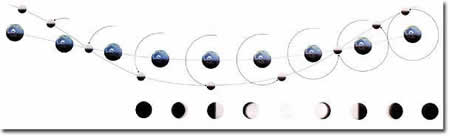
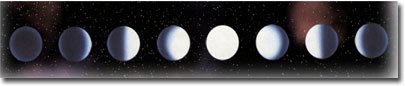
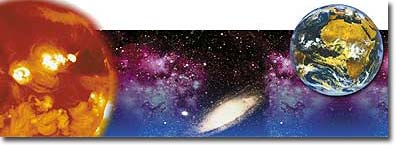 As we know, the only source of light in the Solar System is the Sun. With advances in technology, astronomers discovered that the Moon was not a source of light but that it merely reflects the light reaching it from the Sun. The expression "lamp" in the above verse is a translation of the Arabic word "sirajan," which most perfectly describes the Sun, the source of light and heat.
In the Qur'an Allah employs different words when referring to such celestial bodies as the Moon, the Sun and the stars. This is how the differences between the structures of the Sun and Moon are expressed in the Qur'an:
Do you not see how He created seven heavens in layers, and placed the moon as a light in them and made the sun a blazing lamp? (Qur'an, 71:15-16)
 In the above verse, the word "light" is used for the Moon ("nooran" in Arabic) and the word "lamp" for the Sun ("sirajan" in Arabic.) The word used for the Moon refers to a light-reflecting, bright, motionless body. The word used for the Sun refers to a celestial body which is always burning, a constant source of heat and light.
On the other hand, the word "star" comes from the Arabic root "nejeme," meaning "appearing, emerging, visible." As in the verse below, stars are also referred to by the word "thaqib," which is used for that which shines and pierces the darkness with light: self-consuming and burning:
It is the star that pierces through darkness! (Qur'an, 86:3)
We now know that the Moon does not emit its own light but reflects that reaching it from the Sun. We also know that the Sun and stars do emit their own light. These facts were revealed in the Qur'an in an age when mankind simply did not have the means to make scientific discoveries of their own accord. It was an age when peoples' knowledge of celestial bodies was severely restricted, to say the least. This further emphasises the miraculous nature of the book of Islam.
by. harun yahya
to be continue........
Until the mid-20th century, the prevalent view across the world was that the universe was infinite, had existed forever and that it will continue to do so for all time. According to this view, known as the "static universe model," the universe had no end or beginning.
In maintaining that the universe is a collection of fixed, static and unchanging substances, this view has constituted the basis of materialist philosophy and has consequently rejected the existence of a Creator. However, as science and technology progressed during the 20th century, the static universe model has been completely uprooted.
We have now entered the 21st century and a new dawn is upon us. Through numerous experiments, observations and calculation conducted by some of the world's most prominent thinkers, modern physics has proven that the universe did indeed have a beginning, that it came into being from nothing in a single moment in a huge explosion. Furthermore, it has been established that the universe is not fixed and static, as materialists still stubbornly maintain. On the contrary, it is undergoing a constant process of movement, change and expansion. These recently-established facts all act as nails in the coffin of the static universe theory. Today, all these facts are universally accepted by the scientific community.
The origin of the universe is described in the Qur'an in the following verse:
He is the Originator of the heavens and the earth. (Qur'an, 6:101)
This information is in full agreement with the findings of contemporary scientists. As we stated earlier, the conclusion that astrophysics has reached today is that the entire universe, together with the dimensions of matter and time, came into existence as a result of a great explosion that occurred a long time ago. This event, known as "The Big Bang," is the catalyst for the creation of the universe from nothingness. This explosion, all parties in the scientific community agree, emanated from a single point some 15 billion years ago. (See Harun Yahya, The Creation of the Universe, Al-Attique Publishers Inc. Canada, 2000)
Before the Big Bang, there was no such thing as matter. From a condition of non-existence in which neither matter, nor energy, nor even time existed-and which can only be described metaphysically-matter, energy, and time were all created in an instant. This fact, only recently discovered by modern physics, was announced to us in the Qur'an 1,400 years ago.
THE EXPANSION OF THE UNIVERSE
In the Qur'an, which was revealed fourteen centuries ago at a time when the science of astronomy was still primitive, the expansion of the universe was described in the following terms:
And it is We Who have constructed the heaven with might, and verily, it is We Who are steadily expanding it. (Qur'an, 51:47)
The word "heaven," as stated in the verse above, is used in various places in the Qur'an. It is referring to space and the wider universe. Here again, the word is used with this meaning, stating that the universe "expands." The Arabic word "moosiaaoona" in the term "inna lamoosiaaoona," translated into English as "it is We Who are steadily expanding it", comes from the verb "evsea," meaning "to expand." The prefix "la" emphasises the following name or title and adds a sense of "to a great extent." This expression therefore means "We expand the sky or the universe to a great extent." This is the very conclusion that science has reached today.
Until the dawn of the 20th century, the only view prevailing in the world of science was that "the universe has a constant nature and it has existed since infinite time." However, modern research, observations, and calculations carried out by means of modern technology have revealed that the universe in fact had a beginning and that it constantly "expands."
At the beginning of the 20th century, the Russian physicist Alexander Friedmann and the Belgian cosmologist Georges Lemaitre theoretically calculated that the universe is in constant motion and that it is expanding.
This notion was confirmed by the use of observational data in 1929. While observing the sky with a telescope, Edwin Hubble, the American astronomer, discovered that the stars and galaxies were constantly moving away from each other. This discovery is regarded as one of the greatest in the history of astronomy. During these observations, Hubble established that the stars emit a light that turns redder according to their distance. That is because according to the known laws of physics, light heading towards a point of observation turns violet, and light moving away from that point assumes a more reddish hue. During his observations, Hubble noted a tendency towards the colour red in the light emitted by stars. In short, the stars were moving further and further away, all the time. The stars and galaxies were not only moving away from us, but also from each other. A universe where everything constantly moves away from everything else implied a constantly expanding universe. The observations carried out in the following years verified that the universe is constantly expanding.
In order to gain a clearer understanding of this, let us imagine the universe to be the surface of a balloon being inflated. In the same way that the more the balloon is inflated, the further away the points on its surface move from one another, celestial bodies also move away from one another as the universe expands. This was theoretically discovered by Albert Einstein, regarded as one of the greatest scientists of the 20th century. However, in order to avoid violating the "static universe model" that was generally accepted at that time, Einstein laid that discovery aside. He would later describe this as the greatest blunder of his life.
This fact was explained in the Qur'an in a time when telescopes and similar technological advancements were not even close to being invented. This is because the Qur'an is the Word of Allah: the Creator and Ruler of the entire universe.
THE END OF THE UNIVERSE AND THE BIG CRUNCH
As we have stated above, the creation of the universe began with a huge explosion. From this point, the universe has been expanding ever since. Scientists say that when the mass of the universe has reached a sufficient level, this expansion will come to an end because of gravity, causing the universe to collapse in on itself.
It is also believed that the contracting universe will end in a fierce heat and contraction known as the "Big Crunch." This would lead to the end of all forms of life as we know them. Renata Kallosh and Andrei Linde, professors of physics from Stanford University, made the following statements on the subject:
The universe may be doomed to collapse and disappear. Everything we see now, and at a much larger distance that we cannot see, will collapse into a point smaller than a proton. Locally, it will be the same as if you were inside a black hole... We have found that some of the best attempts to describe dark energy predict that it will gradually become negative, which will cause the universe to become unstable, then collapse... Physicists have known that dark energy could become negative and the universe could collapse sometime in the very distant future... but now we see that we might be, not in the beginning, but in the middle of the life cycle of our universe.
This is how this scientific hypothesis of the Big Crunch is indicated in the Qur'an:
That Day We will fold up heaven like folding up the pages of a book. As We originated the first creation so We will regenerate it. It is a promise binding on Us. That is what We will do. (Qur'an, 21:104)
In another verse, this state of the heavens is described thus:
They do not measure Allah with His true measure. The whole earth will be a mere handful for Him on the Day of Rising the heavens folded up in His right hand. Glory be to Him! He is exalted above the partners they ascribe! (Qur'an, 39:67)
According to the Big Crunch theory, the universe will begin to collapse slowly and will then increasingly pick up speed. At the end of the process the universe will have infinite density and be infinitely hot and small. This scientific theory runs parallel to the Qur'anic explanation of this particular scientific concept. (Allah knows best)
CREATION FROM HOT SMOKE
Scientists today are able to observe the formation of stars from a hot gas cloud. Formation from a warm mass of gas also applies to the creation of the universe. The creation of the universe as described in the Qur'an confirms this scientific discovery in the following verse:
He placed firmly embedded mountains on it, towering over it, and blessed it and measured out its nourishment in it, laid out for those who seek it-all in four days. Then He turned to heaven when it was smoke and said to it and to the earth, "Come willingly or unwillingly." They both said, "We come willingly." (Qur'an, 41:10-11)
The Arabic word for "smoke" in the above verse is "dukhanun," which describes the hot, cosmic smoke in question. This word in the Qur'an, in pinpoint fashion, describes this smoke very accurately for it is a warm body of gas containing mobile particles connected to solid substances. Here, the Qur'an has employed the most appropriate word from the Arabic language for describing the appearance of this phase of the universe. Let us note that only in the 20th century have scientists discovered that the universe emerged from a hot gas in the form of smoke.
The fact that such information about the creation of the universe is given in the Qur'an is nothing short of a miracle of the Qur'an
THE SPLITTING ASUNDER OF "THE HEAVENS AND THE EARTH"
Another verse about the creation of the heavens is as follows:
Do those who disbelieve not see that the heavens and the earth were sewn together and then We unstitched them and that We made from water every living thing? So will they not believe? (Qur'an, 21:30)
The word "ratq" translated as "sewn to" means "mixed in each, blended" in the Arabic vernacular. It is used to refer to two different substances that make up a whole. The phrase "we unstitched" is the verb "fataqa" in Arabic and implies that something comes into being by tearing apart or destroying the structure of things that are sewn to one another. The sprouting of a seed from the soil is one of the actions to which this verb is applied.
Let us take a look at the verse again. In the verse, sky and earth are at first subject to the status of "ratq." They are separated (fataqa) with one coming out of the other. Intriguingly, when we think about the first moments of the Big Bang, we see that the entire matter of the universe collected at one single point. In other words, everything-including "the heavens and earth" which were not created yet-were in an interwoven and inseparable condition. Then, this point exploded violently, causing its matter to disunite.
THE CREATION OF WHAT LIES BETWEEN THE HEAVENS
AND THE EARTH
The Qur'an contains a great many verses concerning the creation of the earth, the heavens and what lies between:
We did not create the heavens and earth and everything between them, except with truth. The Hour is certainly coming, so turn away graciously. (Qur'an, 15:85)
Everything in the heavens and everything on the earth and everything in between them and everything under the ground belongs to Him. (Qur'an, 20:6)
We did not create heaven and earth and everything in between them as a game. (Qur'an, 21:16)
Scientists state that first of all, a mass of hot gas increased in density. This mass later divided into smaller parts to form galactic matter and later still, the stars and planets. To put it another way, the Earth along with stars around it, are all parts which separated from a united body of gas. Some of these parts brought the suns and planets into being, thus leading to the emergence of the many Solar Systems and galaxies. As we have set out in earlier sections of this book, the universe was first in a state of "ratq" (fusion: combined together, united) and then became "fataqa" (divided into parts). The emergence of the universe is described with the most suitable words in the Qur'an, in such a way as to confirm the scientific accounts.
On the occasion of every division, a few particles remained outside the new, fundamental bodies forming in space. The scientific name for these extra particles is "interstellar galactic material." Interstellar matter consists of 60% of hydrogen, 38% of helium and 2% of all other elements. 99% of the interstellar matter consists of interstellar gas and 1% of interstellar dust, which probably consists of heavy elements in small particles of 0,0001 to 0.001 mm in diameter. Scientists regard these substances as very important from the point of view of astrophysical measurements. These substances are so fine as to be capable of being regarded as dust, smoke or gas. However, when one considers these substances as a whole, they represent a larger mass than the total of all the galaxies in space. Although the existence of this interstellar galactic matter was only discovered in 1920, attention was drawn to the existence of these particles, described as "ma baynahuma"-translated as "everything between them"-hundreds of years ago in the Qur'an.
THE PERFECT EQUILIBRIUM IN THE UNIVERSE
He Who created the seven heavens in layers. You will not find any discrepancy in the creation of the All-Merciful. Look again-do you see any gaps? Then look again and again. Your sight will return to you dazzled and exhausted! (Qur'an, 67:3-4)
The billions of stars and galaxies in the universe move in perfect equilibrium in the paths set out for them. Stars, planets and satellites rotate not only around their own axes but also together with the systems of which they are an integral part. Sometimes, galaxies containing 200-300 billion stars move across each others' paths. Yet amazingly, no collisions take place that might damage the great order in the universe. This miracle is something over which all of us should reflect.
In the universe, the concept of speed assumes giant dimensions when compared to earthly measurements. Stars, planets, galaxies and conglomerations of galaxies-whose numerical properties can only be conceived by mathematicians-weigh billions or trillions of tons, and move through space at extraordinary speeds.
For example, the Earth rotates at 1,670 kmph. If we consider that the fastest-moving bullet today possesses an average speed of 1,800 kmph, we can see how fast the Earth is moving, despite its enormous size and mass.
The speed of the Earth as it orbits the Sun is some 60 times faster than a bullet: 108,000 kmph. If we were able to construct a vehicle capable of moving at that speed, it would be able to circumnavigate the Earth in 22 minutes. These figures apply only to the Earth.
Those for the Solar System are even more fascinating. The speed of that system is such as to exceed the bounds of reason: The larger the systems in the universe, the greater their speed. The Solar System's speed of orbit around the centre of the galaxy is 720,000 kmph. The Milky Way, with its 200 billion or so stars, moves through space at 950,000 kmph.
There is no doubt that there is a very high risk of collisions in such a complicated and fast-moving system. Yet nothing of the sort actually happens and we continue with our lives in complete safety. That is because everything in the universe functions according to the flawless equilibrium set out by Allah. It is for this reason that, as stated in the verse, there is no "discrepancy" in the system.
THE STRUCTURAL DIFFERENCES BETWEEN THE SUN, THE MOON AND THE STARS
We built seven firm layers above you. We installed a blazing lamp. (Qur'an, 78:12-13)
In the Qur'an Allah employs different words when referring to such celestial bodies as the Moon, the Sun and the stars. This is how the differences between the structures of the Sun and Moon are expressed in the Qur'an:
Do you not see how He created seven heavens in layers, and placed the moon as a light in them and made the sun a blazing lamp? (Qur'an, 71:15-16)
On the other hand, the word "star" comes from the Arabic root "nejeme," meaning "appearing, emerging, visible." As in the verse below, stars are also referred to by the word "thaqib," which is used for that which shines and pierces the darkness with light: self-consuming and burning:
It is the star that pierces through darkness! (Qur'an, 86:3)
We now know that the Moon does not emit its own light but reflects that reaching it from the Sun. We also know that the Sun and stars do emit their own light. These facts were revealed in the Qur'an in an age when mankind simply did not have the means to make scientific discoveries of their own accord. It was an age when peoples' knowledge of celestial bodies was severely restricted, to say the least. This further emphasises the miraculous nature of the book of Islam.
by. harun yahya
to be continue........
Last edited: