![]() | |||||||||||
| |||||||||||
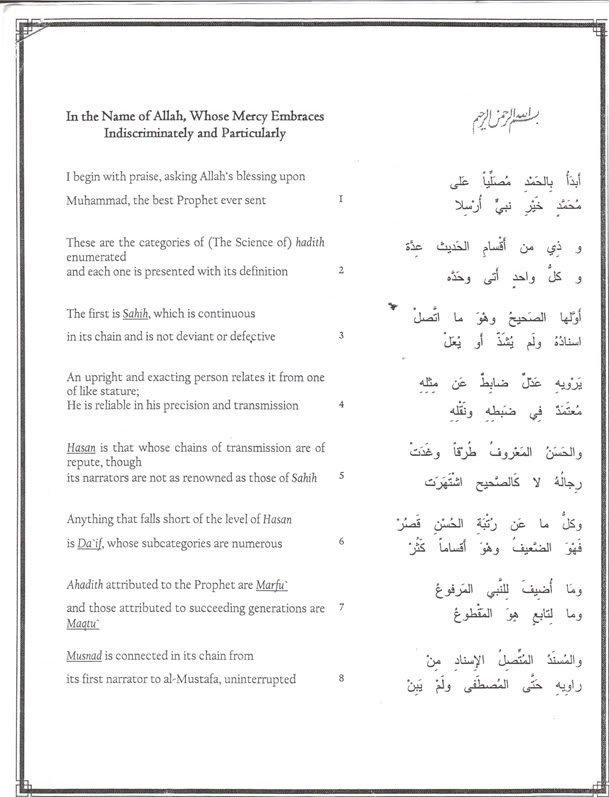
| الأ ثرية Status: Offline Posts: 7,331 Reputation: 29764 Rep Power: 65 Join Date: Jul 2005 Location: ~ Daar as-Sa'aadah ~ Gender: Way of Life: Muslim | I made these notes after listening to Yasir Qadhi's explanation of the sciences of hadeeth (part 1). Can you check if I put it down right, and correct any mistakes... or possibly help me to make it easier to understand. Sciences of Hadeeth Categories of hadeeth: Acceptable: - Saheeh lidhaatihi (Authentic according to its own merit)Da’eef (weak): 1. The isnaad is not continuous or complete:Da’eef jiddan (very weak): 2. The narrators are not ‘Adl: Mawdoo’ (fabricated): 2. The narrators are not ‘Adl: The Classification of a Hadeeth depending on its final authority: o Marfoo’: Linguistically this means ‘raised’. If the hadeeth goes back to the authority of the Prophet (SAW).Definition of a sahaabi: A person who saw the Prophet (SAW), in the Prophets lifetime, and believed in the prophet, and died upon eemaan. He/she also died within 100 years of the Prophet’s death. This is due to the hadeeth: ‘The Prophet prayed one of the ‘Isha prayed in his last days and after finishing it with Tasleem, he stood up and said, “Do you realise (the importance of) this night? Nobody present on the surface of the earth tonight would be living after the completion of one hundred years from this night.” [Al Bukhari, Vol.1, Book 10, No. 575] Definition of a Mukhadram: A person that lived at the time of the Prophet (SAW), and met the conditions of a companion, except that he never saw him. ![]() ![]() |
| | |
| الأ ثرية Status: Offline Posts: 7,331 Reputation: 29764 Rep Power: 65 Join Date: Jul 2005 Location: ~ Daar as-Sa'aadah ~ Gender: Way of Life: Muslim | Part 2. The science of Al Jarh wa At-Ta’deel Jarh: To accuse the narrator of being unacceptable in his transmission of hadeeth. So you are either accusing his ‘adl (trustworthiness) or his Dhabt (strength of memory). Ta’deel: To make the narrator trustworthy and of an acceptable memory. This was performed by a special category of muhaditheen of every generation, by the form of testing. Important Note: The Companions are above jarh wa ta’deel, as they are companions of the Messenger of Allah, and Allah has praised them. So if a tabi’ee were to mention that he heard a hadeeth from ‘a sahaabi’ without mentioning his name, the hadeeth would still be Saheeh as all the sahaaba are trustworthy. In fact, Bukhari has a hadeeth where this occurs in Saheeh al-Bukhari. Many scholars wrote books on jarh wa ta’deel. There are more than 70-100 in print and available in our times. Later scholars had an advantage over earlier scholars, as they had access to books that earlier scholars did not have access to. So they compiled the earlier works of scholars. o Imam Bukhari wrote a book at the age of 18 on Jarh wa Ta’deel, named at-tareekh al-kabeer (the big history). This is published in about 8 volumes. This was his first book.These are the more important works of jarh wa ta’deel. Categories of jarh wa Ta’deel: From highest to lowest; Ta’deel o Extreme words of praise, e.g. Imaam of the Dunyaa, shaykh-ul-Islaam, Imaam-ul-Muhaditheen, Haafidh-ad-Dunyaa or ‘I don’t know anyone of his status’, etc. This is very rare and limited to the highest scholars such as Sufyaan ath-Thawree, Ahmad ibn Hanbal, Imam Bukhari, Sufyaan ibn ‘Uyainah.Jarh o The slightest term for weakness, e.g., ‘people talk about him’ (meaning the scholars of hadeeth), ‘we have our doubts’.Types of Hadeeth Books, and Examples Jawaami’ (comprehensive): These would include fiqh, Tafseer, history, qasas of the anbiyaa, ‘aqeedah. An example of this would be; o Al Muwatta of Imam Malik ibn Anas (D.179).Sunan: Concentrated on fiqh, and this was the primary purpose. o Sunan Abee Dawood, by Abu Dawood Sulayman ibn ‘Ash’ath as-Sijastaanee (275). This is the most authentic of the sunan works.Musnad: Arranged according to the sahaabi. o Musnad of Ahmad ibn Hanbal (D.241). This is the most prominent of the Musnad books.Mu’jam: Arranged alphabetically based on the shaykhs of the student. o Mu’jam of at-Tabaraani (D.370). He had three mu’jams;‘Ilal: Books describing the ‘Ilal of hadeeth. o The most famous being that of ad-Daaraqutnee. This is comprised of 11 volumes.Ajzaa': Small books on a small topic, similar to a pamphlet. ![]() ![]() |
| | |
| Moderator Status: Offline Posts: 952 Reputation: 7256 Rep Power: 28 Join Date: Dec 2005 Gender: Way of Life: Muslim | On the topic of Hadith Sciences, an excellent set of 20 lectures on the topic can be found here: http://islamlecture.com/mustalah.htm |
| | |
| Moderator Status: Offline Posts: 952 Reputation: 7256 Rep Power: 28 Join Date: Dec 2005 Gender: Way of Life: Muslim | I found this http://www.islamicboard.com/581917-post1.html (Introduction to Mustalah-Hadeeth [Lectures]) the links are all there, and they save in the mp3 format. |
| | |
| Eesa Abdullah Status: Offline Posts: 5,784 Reputation: 22602 Rep Power: 51 Join Date: Jan 2006 Gender: Way of Life: Muslim | Quote:
The way you used Dhabt is abit confusing. Pretty nice though إتبعوا ولا تبتدعوا، فقدكفيتم، وكل بدعة ضلالة Follow (the Sunnah) and do not innovate (into it), for verily you have been sufficed. And every innovation is a misguidance. Confused about which religion is true? How can I know? Come and check out some proposed fundamental principles (#1 , #2) to aid you in making a decision. | |
| | |
| Account Disabled Status: Offline Posts: 7,320 Reputation: 18127 Rep Power: 0 Join Date: Mar 2006 Location: 16°53'39.06"N 43°48'5.35"E Gender: Way of Life: Muslim | Quote:
Hey there sis. I'd just like to add that I've never really heard of that part before (in the bold). The Ta'reef (definition) that's commonly used is: A person who saw the Prophet (Salallaahu 'alayhi wasallam) in the Prophets' lifetime, and believed in the prophet, and died upon that state (of Eemaan). Wallaahu a'lam. You may want to re-check that sis? If that's what the sheikh gave then, I'd really like to know why? hmmm. | |
| | |